
Epoxy Floor Repair
Cracks, peeling, and surface wear on an epoxy floor each point toward different causes — and the right response depends on what those causes actually are. Some situations call for targeted spot work; others require stripping the existing coating and starting over. The contractor reviews the floor before making any recommendation.

The Short Answer
Damage on an epoxy floor tends to read like a diagnostic: cracking or chipping from impact or slab movement, delamination where the coating's bond to the concrete has broken down, and surface wear from traffic or chemical exposure. Each pattern suggests different origins and opens different options. A professional evaluation of the floor — what has failed, how far it extends, and what the slab looks like beneath — is the right starting point.
Common Problems With Epoxy Floors
Each pattern suggests different origins and opens different options.
01
Cracks & Chips
Two types of surface damage come up frequently in repair assessments. Chips trace to above-surface events — a dropped tool, an object making contact with the floor. Cracks in an epoxy finish usually originate in the slab: settlement, load changes, or movement that propagates upward through the coating. When the problem is contained and the surrounding coat is still holding its bond, targeted spot work may be practical — the contractor makes that call after looking at what is driving the damage.
02
Peeling & Delamination
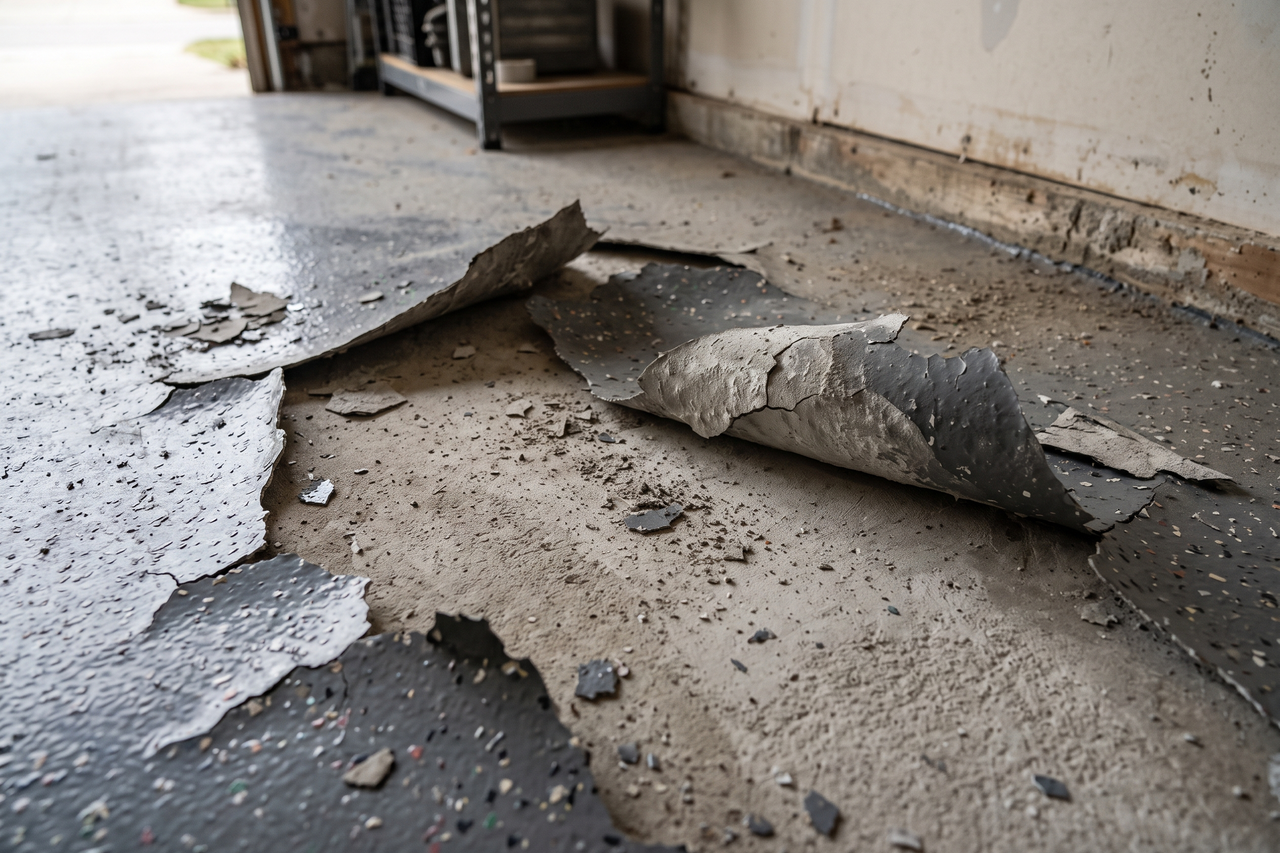
A peeling coating is evidence that the bond has already given way — and once separation starts, it rarely stays confined to where it first appeared. Adhesion failure usually points back to one of a few preparation-related origins: moisture the original installation didn’t account for, concrete that wasn’t profiled adequately, or a previous coating that wasn’t removed before the new product was applied. What drove the failure determines what any repair needs to accomplish.
03
Stains & Surface Wear
Surface discoloration and gradual dulling from traffic represent a different category than adhesion failure. When the coating has degraded visually while the layer beneath remains fully bonded, a fresh topcoat may restore the surface. Confirming that the existing bond is intact and checking the overall state of the current material happens before that decision is made.
How Do Professionals Repair Peeling or Damaged Epoxy Floors?
Evaluation comes first. The contractor determines how much of the existing coating still holds its bond, traces what drove the failure, and assesses the concrete beneath the damaged zones before anything new is introduced.
Delaminating or peeling material gets removed — not covered over. Coating that rings hollow under a tap, or separates with little force, has already lost its adhesion. Adding product over it relocates the failure point rather than correcting it. Once the failing material is taken off, the exposed slab is cleaned and profiled before any repair product or new coating is introduced.
When delamination is widespread, the scope tends to shift from spot repairs to a full recoat. The contractor assesses the full picture before making any recommendation.
Preparing the exposed concrete properly is central to any repair — not a secondary consideration. Our concrete preparation guide explains what that process involves.
Can an Epoxy Floor Be Repaired, or Does It Need to Be Replaced?
Repair and full replacement are both legitimate outcomes. Which one applies depends on how much of the coating is still properly bonded and what originally caused the damage.
Stripping isn’t always the answer. Concentrated damage with clear boundaries — a localized delamination patch, chips in a defined zone, or a single stable crack — can often be addressed without reinstalling the full floor. Where the surrounding coating is intact and well-bonded, fixing the affected section can extend the floor’s useful life considerably.
A full strip and recoat makes more sense when failure has spread across a broad portion of the floor, when moisture was a factor that was never addressed in the original installation, or when the floor’s condition has dropped below what surface-level treatment can realistically restore.
Visual review alone often leaves questions unanswered. A contractor who can probe bond strength and evaluate the concrete directly gives you a much clearer picture of what the floor actually needs. When starting fresh is the better answer, our epoxy floor installation guide covers what that project involves from preparation through the finished floor.
How Much Does Epoxy Floor Repair Cost?
A single price figure for epoxy floor repair would be misleading — the job spectrum runs from filling a hairline crack to stripping and recoating an entire space. Project totals turn on damage character and extent, how much of the old coating must come off, the concrete’s condition below, and the preparation scope the repair demands.
Without a floor-specific review, any number would misrepresent the range. The estimate comes from examining the actual slab — not from applying a blanket rate.
What Causes Epoxy Floors to Fail, and How Can You Prevent It?
Whether you are diagnosing a current problem or planning an installation you want done right, understanding what makes coatings fail is worthwhile. A short list of recurring causes is behind most cases of premature failure.
Improper Concrete Preparation
Poor preparation is often part of the problem when an epoxy floor begins failing early. A slab that wasn’t ground to the right profile, residue from a prior coating, or surface contamination left in place can each stand between the new product and the mechanical bond it needs. A coating applied under those conditions may look adequate at first, then gradually separate as the weak bond breaks down.
Preparation is a distinct phase of the project — not a formality. Our concrete preparation guide explains what a professional prep process involves from start to finish.
Excess Moisture
Vapor moving upward through a concrete slab is among the less visible causes of coating failure — and one of the more frequent. When pressure builds at the interface between slab and coating, it pushes against the adhesive bond from below. Bubbling, blistering, and gradual separation that doesn’t appear until well after installation are the typical signs.
Preventing this failure mode requires action before any coating goes down — slab testing that gives the contractor real data about what the floor is doing. Without those measurements, product selection rests on assumptions.
Heavy Impacts and Chemical Exposure
Every product has an operating envelope. Heavy dropped equipment, extended contact with out-of-tolerance chemicals, and high-abrasion use all erode a coating over time — even a correctly installed one. What the floor faces every day determines whether a given system is the right fit. There is no universal specification — the match depends on the space’s specific demands.
Improper Installation or Curing
Good preparation creates the conditions for a durable result — but application errors can undermine those conditions. Wrong mix ratios, working outside the product’s temperature and humidity parameters, cutting short the time between coats, and inadequate curing conditions are each capable of compromising the outcome.
Before work begins, the installer outlines the curing timeline and what conditions must be maintained. When poor application drove the failure, reinstalling under the right conditions may be the correct course. Our epoxy floor installation guide explains what a properly executed installation involves.
Can Garage, Basement, and Commercial Epoxy Floors Be Repaired?
Each type of space brings its own variables to a repair evaluation. Damage character and the floor’s daily demands both shape what the right path looks like.
Garage Floor Repair
Vehicles, temperature swings, chemical spills, and tool impacts all take a toll on garage floor coatings. Chips, stable cracks, and limited delamination come up regularly in garage assessments. When damage is contained and the rest of the floor is still holding, addressing the affected area may be the practical response. Widespread chemical degradation, extensive tire marking, or broad adhesion loss often shifts the conversation toward a full strip and recoat — a determination the contractor makes after reviewing the slab. Our garage floor coatings page covers what a properly installed garage coating involves.
Whether the garage can stay partially usable while repair work proceeds depends on scope and what the contractor determines is practical. That conversation happens during the estimate.
Basement Floor Repair
Basement coating failures involve moisture more often than failures in most other settings — and that shapes what any repair needs to actually address. If the original coating came off because moisture wasn’t controlled from the start, the repair has to include that underlying issue, not just the surface. Putting a new coating over the same unresolved conditions produces the same result.
Both the coating’s current state and the slab’s moisture profile factor into the contractor’s assessment before any path is recommended. Our basement floor coatings page covers what a sound basement coating project looks like from the beginning.
Commercial Epoxy Floor Repair
A failing coating in a commercial space creates more than an aesthetic problem — traffic safety, cleanliness, and the overall condition of the work environment are all affected. When failure is contained to a clearly bounded area with sound coating around it, targeted work can be worth pursuing. Broader adhesion loss across a larger share of the floor often points toward a more extensive approach.
Whether staged work is possible — keeping part of the space in use while repairs proceed elsewhere — depends on project scope and what the contractor judges as workable. That gets resolved during the estimate. Our commercial epoxy flooring page covers what commercial coating projects typically involve.
Frequently Asked Questions About Epoxy Floor Repair
Can I patch a peeling epoxy floor myself?
Off-the-shelf repair kits exist, but using one without identifying the underlying cause rarely produces a lasting result. If peeling traced to moisture, a surface that was inadequately prepared, or a product incompatibility, patching over that without fixing the conditions restarts the clock on the same failure. Getting to the root cause — not just the surface symptom — is what changes the outcome.
How do I know if my floor needs repair or a full replacement?
How broadly the coating has lost adhesion drives the answer. A contractor can physically probe and test the existing surface to determine what share still holds its bond. Contained failure leaves room for targeted repair. Widespread bond loss across a significant share of the floor generally points toward a full strip and recoat.
How long does an epoxy floor repair take?
Project duration reflects how much floor is involved, what preparation the concrete needs, and the product being applied. Before work begins, the installer covers the schedule — including when foot traffic is appropriate and when heavier use or vehicles can return.
Will a repaired section match the rest of the floor?
Match quality depends on the coating’s age, the original product, and the scope of the repair. The contractor sets realistic expectations based on those variables before the project starts. When appearance consistency is the priority, a full-floor recoat often produces more uniform results than isolated patching.
Is moisture always why epoxy floors peel?
Moisture is a common contributor but far from the only one. Preparation shortfalls, applying product over an incompatible surface, poor application technique, and inadequate curing time each represent their own failure path. The contractor uses the location and pattern of the problem to identify the most likely origin.
Does a repair come with a warranty?
Coverage terms, when any are offered, come from the contractor and reflect the nature and scope of the work. Confirming what is covered — and under what conditions — should happen directly with the contractor before the project begins.
Ready to Evaluate Your Floor in Mendota, IL?
When an epoxy floor is cracking, peeling, or wearing down, a professional look at the slab’s condition is the right place to start. We’ll work to connect you with an independent flooring contractor who can examine the floor, identify what is driving the problem, and, if it’s a fit, prepare a customized estimate for your project.